Loading
Loading
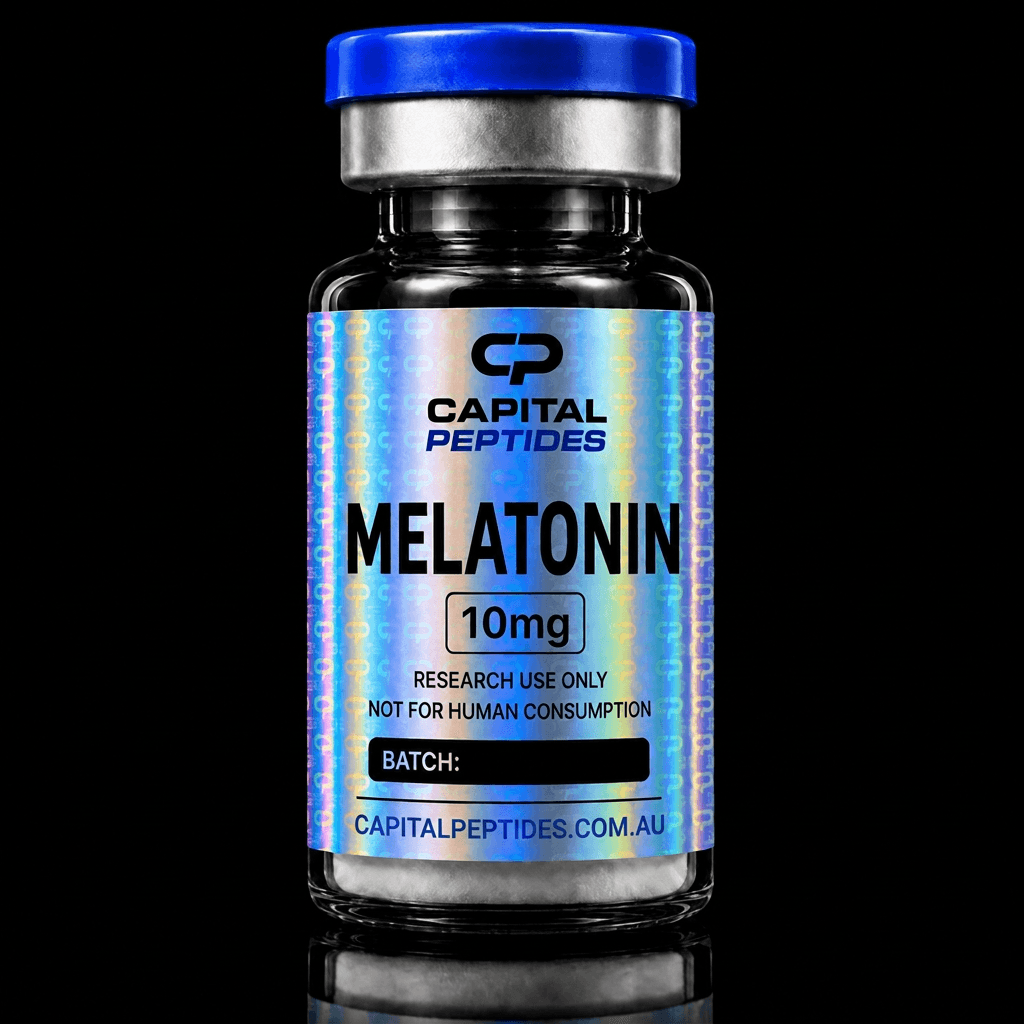
Cognitive & Nootropic · 10mg
Delivery & pricing
⚡ Order before 9 am weekdays for same-day dispatch.
Choose pack size
$62
AUD · 1 vial
10 vials per kit
Melatonin is an endogenous pineal hormone studied in preclinical and clinical research for its circadian rhythm regulation and antioxidant properties. Research has examined its potential to bind MT1 and MT2 melatonin receptors to shift the sleep-wake cycle, reduce sleep-onset latency, regulate core body temperature, and scavenge reactive oxygen species. Studies have also explored immunomodulatory and neuroprotective effects in aging and stress models.
≥98%
Purity
Lyophilised
Format
1–3 days
Arrival
Don't want to wait 3 weeks?
Check local stock — weekday same/next-day delivery available.
Chemical Properties
Need to work out your dose?
Use our reconstitution calculator — syringe units in seconds.
Research Use Only — Disclaimer
This product is intended solely as a research chemical for laboratory and scientific study purposes only. It is not approved by the TGA or any regulatory body for human or animal consumption, therapeutic use, or clinical application. The information provided on this website is for educational purposes only. Handling must be limited to suitably qualified professionals operating within applicable laws and regulations. This product is not classified as a drug, food, cosmetic, or medicinal product and must not be used or labelled as such. By purchasing, you confirm you are a qualified research professional and accept full responsibility for compliance with all relevant laws in your jurisdiction.
Melatonin
N-Acetyl-5-Methoxytryptamine
Melatonin (N-acetyl-5-methoxytryptamine) is the primary hormone of the pineal gland, synthesised from serotonin via sequential action of arylalkylamine N-acetyltransferase (AANAT) and hydroxyindole-O-methyltransferase (HIOMT) enzymes, with production tightly coupled to darkness via the retinohypothalamic tract. One of the most extensively researched biological chronobiotics, it is also a potent antioxidant and immunomodulator.
Melatonin acts at MT1 and MT2 G-protein-coupled receptors in the suprachiasmatic nucleus (SCN) — the brain's master circadian clock — to shift and entrain the sleep-wake cycle. MT1 activation acutely inhibits SCN firing (sleep-promoting), while MT2 facilitates phase shifts for jet lag correction. Beyond MT1/MT2, melatonin acts as a direct free radical scavenger (far more potent than vitamin C or E in some assays), activates nuclear RZR/ROR receptors to regulate immune and oncostatic gene expression, and protects mitochondria by preserving electron transport chain efficiency.
Clinical research includes circadian rhythm disorders (jet lag, shift work, delayed sleep phase), insomnia (particularly sleep-onset latency), mitochondrial protection, oncological support (anti-proliferative effects and improved chemotherapy tolerability in trials), cardiovascular health (antioxidant reduction of LDL oxidation), and anti-ageing protocols. Melatonin's neuroprotective properties are under active investigation for Alzheimer's disease and Parkinson's disease.
Key References
For research reference only. All information pertains to preclinical or published human trial data. Not intended as medical advice. This product is for research use only.
Don't have supplies? Grab them while you're here.